When I was a child, I enjoyed Lego sets, Brio trains, my uncle’s old erector sets and the sorts of tactile tasks we had to do to earn Cub Scout badges. It was a pleasure to take arbitrary 3d shapes and using my hands craft them into recognizable structures that fulfilled some aspect of imaginative play. As I grew up, my parents being much older and less technologically inclined than most of my friends’ families, we were the last to have a computer. And I didn’t really see anything of it other than an internet browser and word processor. I missed out on the earliest Mac computers and the 486 PC’s, because they were seen as mostly for early computer fanboys and not really too practical for the average American family. And even though Window’s 95 came to be a very useful and accessible operating system, I think that a lot of the important creative potential of computers remained alien to most people because of this ease of access. As a result, most of us never got a chance to explore coding. Or see computer code as a medium for creative output using a command prompts and scripts.
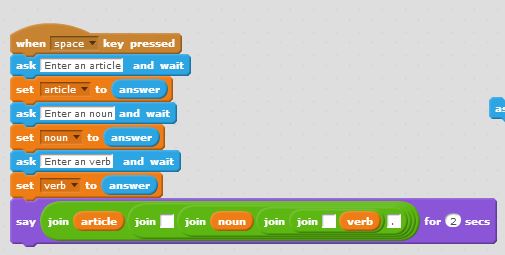
I see Scratch as a way to undo the many abstractions created by the family friendly operating server. The program give individuals tools to create something new. It’s all about control. I think in that way it is very egalitarian. I came to this realization as I was struggling with the problems in Chapter 5 of the text. It is often said when was one is struggling with a concept you should “sleep on it” and in the morning clarity will find you. This was very true for the problems I struggled with over the weekend and last week. Especially concerning the problem (#5) that asked us to create a program that wrote a simple three word sentence script. I could not understand how to create the script so that they sprite would not just repeat the answer to the last question three times. Suddenly, I understood how the variables are meant to be used appropriately and it all made sense.

 Julian A. Elorduy, MET, MA