Last Night I Had A Dream

Last night I had a dream that I think was all about humility. At the beginning of the episode, I was a king hosting a large party at a beautiful home near the ocean. Waves started crashing and the water rose to the level of the house. Boats started crashing toward the home. Before being destroyed the scene changed to a new environment. Each new scene provided a new puzzle or a doom-filled scenario. I maintained throughout the dream that I had all the answers… if I only opened the door and ran away, I would be safe. I was a king. Every time I opened a door or tried to do my best to escape to safety another door would close in front of me.

I woke up in the middle of the night tossing and turning from the dream trying to wonder what meaning it had for me. Was it a vision of what hell is like? Is that ultimate suffering?

A discovery! It is! According to the Mystery of Suffering and Death text, hell can be now and hell can be forever. It is a state from which and for which nothing can escape. It is total annihilation from God.

In the waking hours, I began to process the dream a bit more. I feel like its primary lesson is about connection and community. We are social beings who need connection and support from our earliest days of existence. A baby cannot survive without her mother. Why do we assume that as we grow older we do not need anyone to help or support us in order to survive?  Or why do we expect that other people do not need our attention or concern? Why are we taught from a young age that we determine our self-worth independent of other people? In this way, I think that we are taught more about how to receive and less how to give. I am reminded of Simone Weil who has written about attention and connection, “Attention is the rarest and purest form of generosity.” 

In our society, we become alien to each other with each passing grade in school. I obtain a grade that represents me to the world. It is a grade that I must own. It is not attributed to the effort of the teacher or the school system or my parents or my peers that may have supported me. That grade continues to represent me throughout school despite how many other people along my educational journey may have impacted that journey. Along with grades I am represented by test scores. All of these measures of learning treat me as if I am a singular entity separate from the universe around me and from the people around me. Isn’t the message of the eucharist and Catholic identity about a sense of unity around love. This quote of St. Therese Of Lisieux is included in ALL CAPS in the Catechism of the Catholic Church, “LOVE, IN FACT, IS THE VOCATION WHICH INCLUDES ALL OTHERS; IT’S A UNIVERSE OF ITS OWN, COMPRISING ALL TIME AND SPACE – IT’S ETERNAL!” (CCC 826). 

How can we attribute value to the many different ways we are connected to the world around us that is equal to the value attributed to grades and other individual measures of worth, which seem to have so much currency in our society? Maybe there are ways that we are doing this already. What can we celebrate and emphasize?

Reflection on EdTech 543

When I first registered for courses this summer, I was first enrolled in Mobile App Creation. This class, however, only concerned apps having to do with Android devices. Ultimately, this would not have been very useful for me since our school only uses iPads. So I was a little unsure what to expect from EdTech 543 and I did not have a great deal of expectation leading up to course. Having taken the course, I very much grateful for having had the opportunity. I learned a great deal and made some powerful connections with students in my PLNs. I look forward to implementing some of the skills that I have learned and practiced in the fast approaching school year.

The course began by asking us to connect through Facebook, Twitter and WordPress. I did not expect to be spending so much time in this class on Facebook. At first, it was overwhelming signing up for so many different services. I already had a Twitter and Facebook account, but I mostly used it to gather information, connect with friends and sharing some content and media. This is how, I assume, most people use it. I was not tapped into the powerful capabilities of social media networks for my professional benefit. I previously assumed that social media networks having to do with my professional life were exclusive to sites like LinkedIn, which are specific to developing your online social media presence within professional networks. However, I now feel very much adept at using social media to connect professionally with outside world. I also feel experienced at using social media in the classroom. It is amazing how in such a short period of time I can develop such a different and more complex relationship with the online world. I consider it a blessing to have been required to connect with so many different communities online. I think that I have been using the internet for leisure and entertainment only for too long. Now is the time to use it to it great potential. I feel that I am now a much more efficient user of the internet.

After the course, I also have a much stronger conceptual understanding of the different theories that validate our use of social media in the classroom. I especially enjoyed learning about connectivism, communities of practices and Web 3.0. The idea of the augmented reality has been coming up a lot recently, since I have become aware of it through this class. Interestingly, it coincided with the release of Pokemon Go, which is a new way of seeing and interacting with that reality. At my school, there has been a bit of a backlash concerning Web 3.0 and students’ use of the iPad. Many educators believe that students are spending too much time on their devices and losing sight of the value of real-time person to person communication. This movement in the school is coming from  studies that are showing that techie-teens are less empathetic than previous generations. My opinion on this subject is that the only absolute in teaching is that aging teachers have always been reticent to adopt changing pedagogy and technology and I believe that if educators do not work with and for the growth of technology in this world they will find themselves obsolete. Our public schools are not improving and peoples personal and professional lives are finding themselves more and more on the web. The next generations of students may never set foot in a classroom. Or they may only set foot in a classroom part of the time or for seminars. Whatever model may take shape in the future, one thing is certain, technology will play a central role.

Concerning the importance of technology, we must also consider the importance of our digital footprint in this age of the augmented reality.  I understand now that our digital identity can be a deal breaker concerning our employment.  I also now plan on buying up web space to  start creating my online brand. I just am curious how I can make my brand marketable. During the online Twitter Chats, I found several very inspiring educators who have branded themselves and create content more than just share content. I see many ways that education can develop and grow and become more accessible to different groups. One of the most powerful aspects of technology is the ability of its tools to level the playing field and allow students of different economic levels to access online courses cheaply and have meaningful experiences without needing to afford costly tuition. MOOCs  like Code Academy and others create learning opportunities for students a little more no cost. There is then the idea that possibly internet access should be a human right like access to drinking water, clean breathable air and quality education. I believe that the current president sees this as something to work towards. I hope that future leaders see how important this is also.

Social Media Policies

The follow are guidelines for creating a safe and productive environment for using social media in the classroom. Students are Sophomores and Seniors and very much adept at using social media. The goal of these guidelines is to foster appropriate and responsible behavior respecting the power of social media and the worldwide web.

Religious Studies Classroom Social Media Policies & Guidelines

Mr. Elorduy uses social media as a tool to engage students in learning using technology as a part of our 21st century learning plan.  The following information is intended to supplement school-wide policies contained in the Parent-Student Handbook.  Parents and student should be familiar with this document as it is required reading for attendance at this school.

Social media is a platform that allows individuals to communicate, share and create content in real-time or asynchronously through direct messaging, and public and group posts. It allows users to track hashtags and search for specialized content. Social media is a very relevant and useful tool for modern life. However, with that usefulness come certain responsibilities that need to be understood and taken into consideration before posting publicly or privately. Digital information in the form of your digital footprint can be available for a very long time. Users must exercise judgement to ensure courtesy, respect and kindness. They also must consider social media as a tool for serious learning. One’s online presence should be considered a serious reflection of personal character.

As a 1:1 iPad school, Christian Brothers High School of Sacramento requires that students bring their devices with them to every class. In your religion class this year, you will be required to have your iPad charged and ready for class. Along with your iPad, occassionally other devices are permitted for use in class when approval is given by your teacher. Such devices are:

  • Smartphones
  • Video Recording Equipment
  • Laptops

The following are guidelines which apply when devices are used in class. They are not meant to replace or supersede good judgement and responsible use policies stipulated by the school administration:

  • Students should be carefully transparent and honest online to facillitate good discussion and sharing
  • Students should be mindful of professional and personal use of social media use separate accounts whenever necessary
  • Social media interaction inside and outside of class should be respectful and appropriate
  • Appropriate language is to be used at all times, however, grammar and conventional language mechanics do not necessarily apply
  • Students should be aware of privacy settings and use discretion with posts
  • Any form of bullying or harassment is grounds for being reported to the Dean
  • Students are to be mindful that they are representatives of the school and should uphold school values at all times
  • Students will gain much more from their social media presence if they maintain a positive and constructive presence online
  • Occasionally, students and teachers make errors when posting online. Please respond respectfully to constructive feedback.
  • Students should be conscious of the type of media posted publicly online, especially concerning video and photos of school students

Mr. Elorduy’s religion class is designed to be a productive and positive learning environment. The quality applies to student interaction inside and outside of class. Students are to be mindful of the policies listed above, but also practice good judgement. If a student is unsure of how to respond to questionable activity online, that student should never hesitate to seek the help of Mr. Elorduy or another adult.

References:

Click to access Social%20Media%20Guidelines.pdf

http://socialmediaguidelines.pbworks.com/w/page/17050885/Student%20Guidelines

Click to access edutopia-anderson-social-media-guidelines.pdf

Social Media in High School Education

This week I went through Pinterest and Google looking for examples of successful uses of social media in classroom assignments. There is a great deal of content available, however, I can see how there is a lot room to explore new and different ideas for using Social Media in the classroom. Please visit the link to my Pinterest board where I mentioned all the different classroom learning ideas that I discovered while doing my search. In the comments, I also described some simple and straight forward ideas for applying these techniques in the high school classroom setting.

The examples listed in the board show how students can use social media for assessment, research, and communication. I appreciate that there are several example from high ed for using social media, because sometime I feel that the elementary and secondary school levels are unique in using education technology so extensively. However, students are on social media. In many ways their personal relationships and online relationships are deeply inter-connected; you cannot have one without the other. Therefore it will be very useful for teacher to tap into this world. I want students to see that they content teaching it relevant to their world. If we use social media we can have students personal lives interconnect with their learning.

I think that the most inspiring use for social media in the classroom is for re-creating the PLE and PLNs for students to use. I want to use Twitter in a safe way to allow students to communicate with each other and outside world on issues that are relevant to the class.

Webinar on Education Technology

edtech webinar.PNGEducation Week – Teachers Perspectives on Education Technology
This webinar discussed the results of a survey on EdTech conducted on the Education Week website. According the presenter, it represented diverse community of teachers, but does not statistically reflect the teachers across the United States. The data states that many teachers do not have a positive outlook on the current state of Education Technology, however, the outlook on the future looks slightly better for teachers.

It seems that these issues have to do mainly with the fact that, even though every single stakeholder in education understands that Education Technology must play a part in student education, not everyone understand how it should play out and where resources should be spent when technology changes so quickly. I seems that companies of hardware and software are in a winning position financially, while schools are in a losing position. If the next phase of our existence contains an augmented reality.

I am deeply concerned that a large majority of children and their parent may be left out when access to the technology necessary to participate in the augmented, asynchronous reality is not available. I look forward to governments and companies find ways to solve this issue and increase funding and professional development for teachers everywhere who might be intimidated by education technology.

My PLE Diagram and Reflection

PLE Diagram (1).png

This week for Module 5 we were asked to create a Personal Learning Network (PLE) diagram to show our connections to various online communities and resources that we frequent. I used a new platform for me called, Draw.io. However, it works almost identically to Gliffy. I will say that I used the benefit of other students’ diagrams to help craft my own. I certainly made it easy not to be the very first one to submit.

I think that in this world we are sometimes overly connected. However, I have come to revise my thinking on this subject. According to Clay Shirkey, we are not suffering ever from a information overload, rather a failure to filter. In a similar way, I do not think we are ever overly connected, but we do not make the best use of our connections. I often find myself lurking in the shadows and not making an contributions to online communities. This week has been a wonderful lesson in becoming  a participant. I look forward to using this skill more in the future.

I reviewed the diagrams of Allison Pengilley, Amanda Hensley, Kimmy Davis and Megan Apgar. I noticed a lot of continuity between the content of each diagram. I also noticed a lot of variety and creativity in the my fellow students’ means for capturing their PLE diagram. I especially liked Amanda Hensley’s connectivity plate. By showing each connection as a serving on a plate, she creatively indicated which network is most important to her and, on which, she spends to the most time developing connections. Allison Pengilley’s was the most inspiring to me because it was the cleanest and one of the most visually attractive. I tried to emulate that level of cleanliness and took advantage of the tools available in the Draw.io software. I, also, noticed that Allison’s diagram included a couple resources that I use, but would have neglected to include, such as, Pinterest and Google Drive. So, I made sure to include them in my diagram. Thank you all for your great efforts and being an inspiration to me in my EdTech networking journey!

Twitter Chats for EdTech 543

Below are my reflections on my discussions in these Twitter chats. It was a very inspirational journey. There are many people working hard to brand themselves and produce and curate great content for the Twitter world. I look forward to using some of their ideas and tools to help myself in my career in education. twitter chat - best classroom

#sunchat (7/3/2016)

A collection of inspirational resources regarding education. I am very fascinated with this approach to personal development. It makes the process, so incredibly fluid and increases the amount of exposure to content from educators. In one post, I replied to Dr. Randall Sampson’s message, “Innovative schools have a clear focus on the continuous development of their teachers.” I have found this to be so true. In my last school there was not vision for development and it has a strongly negative effect on enrollment and morale. I also discovered a useful diagram showing the importance of peer evaluation in education. I replied, reposted and liked posts that struck a chord with me.

#edslowchat (7/3/2016)

Today a question was posed asking teachers what they are reading. It was very interesting to discovered that there weren’t just a random collection of various education related texts being reposted, but that there are a number of buzz titles that were listed several times. Those included, Hacking Leadership by Joe Sanfelippo, Kids Deserve It by Todd Nesloney, and Launch by John Spencer. I was able to like posts feature texts that I would like to read and I shared some of the texts were are reading this summer for the EdTech program.

#sunchat (7/10/2016)                                 

Today several interesting subjects came up in our chat. One of the most important came from Rita Wirtz (@ritawirtz). She linked to an article she has written having to do with the instance of problem children finding their way into the penal system, because the school system could not save them. I replied at having been inspired by her writing, but I was a little disappointed she didn’t point the readers to any solutions or any resources of groups that are working to address the issues she brings up. I also came across a link to an article on Elie Wiesel. It was a beautiful article. I teach about the history of persecution against the Jews in my comparative religion classes. It is always necessary to revisit Elie Wiesel writings. I appreciated being reminded of his words today on the chat.

#edchat 7/11/2016

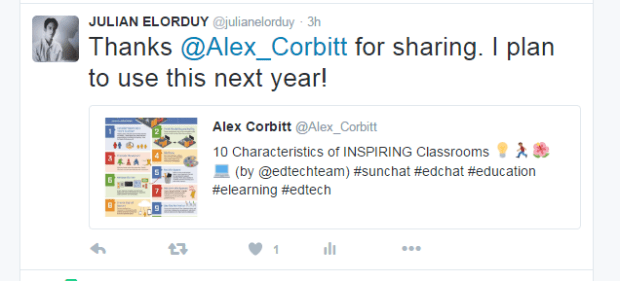
During todays on-going chat on education, I found some great content and some inspiring content curators. Alex Corbitt is a teacher in Bronx, NY. Today, he posted an infographic describing 10 characteristics of inspiration creating classrooms. He has a focus on socio-emotional learning and gamification in the classroom. I reposted and commented on the infographic that he posted. Aside from Mr. Corbitt, there is a wealth of resources following this hashtag and a majority of the content to applicable and focused. Twitter does a great job of filtering content that is not suitable for the discussion. The Google Plus communities do not have this benefit.

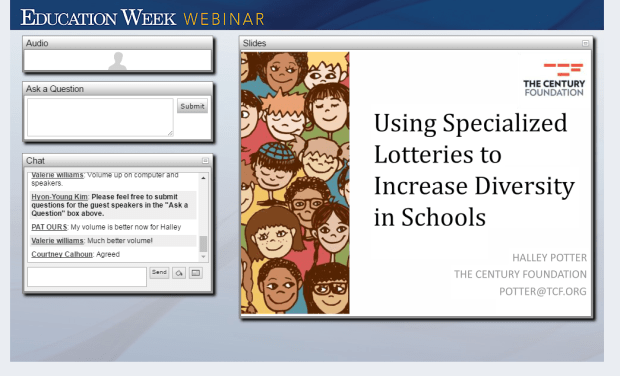
Education Week Webinar – Using Lotteries to Increase Diversity in School Districts

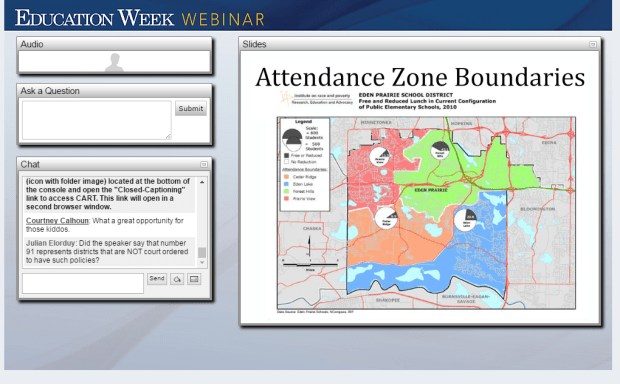
This webinar is a discussion of strategies for integration in school districts, specifically using lotteries in increase diversity. The key presenter shows that since 1996 to the present day the number of districts with integration policies have increase dramatically. However, there is still a long way to go. Strategies include redrawing district boundaries and choice-based integration. Choice based integration strategies include magnet schools, charter schools, transfer policies, and district-wide equitable choice strategies.

To create effective weighted lotteries the speakers states that districts should consider the landscapes (relationships between schools, enrollment numbers, etc.). And she also believes that diversity goals need to come before choosing a mechanism.  Mechanisms to increase integration and diversity need to be flexible and adaptable so that communities can draw on their strengths and achieve goals more rapidly. Weighted lotteries should come with recruitment by combining attractive schools to draw families into these schools.

The webinar included a presentation from Brooklyn Prospect Charter School. There are a variety of state and federal laws that must be taken into consideration. Charter schools face limitations based on these laws. A voice for Charter schools is the National Alliance for Public Charter Schools informs us that some states are silent on admissions preferences, some expressly permits weighted lotteries, interpreted to permit weighted lotteries for the disadvantaged, some limited the lotteries.Brooklyn Prospect Charter School  is a K-12 College Preparatory. It’s are finding excellent teachers and creating a diverse student body. At the school currently, there is no racial majority, and an even economic split. The schools aims to focus on these goals: (1) A strong academic program (2) strategic facility placement and (3) agile admissions strategies.

The webinar tool is a great resource. I personally prefer asynchronous content, because scheduling time to engage in one of these webinars can be a challenge. However, I liked the immediate feedback and the ability to ask questions in real-time. Webinar - Lotteries for Diversity 2Webinar - Lotteries for Diversity.PNG


Curation Complete: Scoop.it and EdTech’s Effetiveness

Curation for EdTech 543 on Scoopt.it

It took quite a while to narrow in on a topic in Scoop.it. The platform is very attractive and works very well. But it was difficult to find content in specific areas within the Scoop.it search tools. However, I was able to focus on how 1:1, BYOD and education technology are working together in research and studies, either official studies or anecdotal evidence from teachers around the country. In the body of evidence collected in this curation overwhelmingly it appears that schools need to focus on PD and innovation. And teachers need to organize their tech integration for fluidity. Regardless, this subject opened up a lot of content published to online education journals and personal blogs.

See our PLN’s criteria below.

Criteria for Curation

Assessment:

Relevance: When considering the relevance of content in curation:

  1. Has a niche/theme been identified and does the curated piece fit that niche/theme?
    • Each resource fits within the identified niche. 
  2. What is the value of the curated piece in relation to the theme?
    • Each piece of content fits into the theme of trying to assess the effectiveness of Education Technology as it is implemented today. My insights point to directions for further success in addressing challenges in the future. 
  3. Has the piece been filtered for originality and quality?
    • Some resources have been re-Scooped from other Scoop.it users, but otherwise each piece is relevant and unique to the topic and drawn from reputable resources. 
  4. Is there evidence of inquiry in the piece? Going beyond the surface of the theme?
    • I’d like the reader to be presented with a variety of opinions on the subject-matter. So that they can make their own determination on how effective education technology can be in the classroom. 

Authority: When considering authority:

  1. Is there proper attribution in the piece itself?
    • When necessary, each resource is properly attributed. Some pieces are original and do not require attribution.
  2. Does the curated list reference both the presenter and the original creator of the content to the best of the curator’s ability?
    • All resources show proper attribution and are taken from public websites. 
  3. Does the list contain pieces from recognized authorities or creators with credentials or experience?
    • The pieces come from notable authors in the field of education, teachers, bloggers and researchers. 

Purpose: When considering if curated content has a specific and useful purpose, consider the following thoughts:

  1. Is there evidence of editorializing to provide context for the curated content?
    • The selection of each resource adds dynamics to the theme by creating substance and outlining alternative perspectives. 
  2. Is there a summary that provides rationalization for a resource’s inclusion in a curated list?
    • My insight added to each article provides a brief summary and commentary, which highlight the reasons for inclusion. 
  3. If the curator uses a social media site like Twitter to share resources, have they included their own perspective?
    • This post and posts on the Scoop.it sites are posted using #edtech and #edtech543 hashtags. 
  4. Does the information fit into a clearly identifiable theme?
    • All content in the curation fits to the theme of how education technology is working or not working within a school setting.

Presentation: Strong content curation tools must be easy to use, simple, and straightforward. In order to assure that your curated content is presented and shared effectively, think about the following questions:

  1. Has the curator chosen an appropriate presentation tool for its intended audience?
    • Scoop.it is an attractive and focused website used for content curation. 
  2. Does the curated list address the needs of the intended audience?
    • Each piece is intended for educators or administrators who are trying to understand how education technology can be most effective. 
  3. Has the curated listed been organized in a clear, concise, and easy to understand manner?
    • The resources are labeled with accurate titles that point to the meaning of the article. If a title was misleading, I provided insight to clearly identify summary the true content of the article. 
  4. Is the list easily sharable by its users?
    • Scoop.it allows all users to share and re-“scoop” content. 
  5. Is the chosen format updated regularly with new information?
    • Scoop.it allows you to find new resources every time that you login in to the site. 

Criteria for Curation and a Reflection on the Process

Criteria for Curation and a Reflection on the Process – Google Document

This assignment required us to create 15-20 different criteria to use measure our future effectiveness at being quality web curators, who according this article are the “Web’s New Superheroes.” With the deluge of content filling the web, it is increasingly essential for the content to be filtered, analyzed and qualified by talented web curators. I am still learning how this can be applied to education. I would like to study the work of expert education curators on the web and understand how they decide their niche, where they pool for resources and how they manage their workflow, assuming web curation is not their primary job. I look forward to being able to flex these powers in the next weeks.

This assignment required a flexing of our collaborative skills. Our PLN got the ball rolling by creating a Google Document for the list of criteria and frame our discussion. A member of the PLN introduced us to the idea of the CRAAP model by the CSU system. It was a challenge to completely allow the CRAAP test to conform to the guidelines of the assignment. But it did give us a convenient framework, around which, we could organize our criteria.

We ended up using some elements of the CRAAP test and ultimately made it our own. Based on test, added 16 criteria, which, were gleaned from the readings and resources that we gleaned from the web. Ultimately, this was a group effort. But I feel indebted to the hard work of the group in finishing the assignment so early. I would definitely still be working on this if weren’t for the diligence and skill of PLN.