Reflections on the Nature of Digital Footprints…

I find it oddly comforting that if I want to discover information about a person, I can find a lot of it online. As a more introverted person with an innate curiosity of other people, the web provides as a wonderful means of attaining information and doing some people watching via the comfort of my own home. And I do not think I am alone. In many levels of interaction within society, we are compelled to google those people, with whom, we are fascinated. Whether it be a love interest, a colleague or a new friend, we tend to want to know all that we can know about that person. I am not sure this is fair, but it is the nature of our world. Fortunately or unfortunately, a great deal of information can be found in the world about virtually anyone. It is at once comforting and disturbing. But how comfortable should we be with the knowledge that anything that is written about us or content that is created by us can be found online? The internet is not a playground where we are immune from impunity, especially for those of us whose professional lives dwell online and in person.

As for my own digital footprint, there is a legacy of photos, videos and music that I have created since I was 19 or 20. I have been a part of indie, lo-fi music making for over a decade now. It has been a passion that I have carefully balanced with work and school. I believe that it adds a layer to my personality and life-experience and I do not regret it one bit. I only perhaps wish that I had had more time to devote to it more fully. Regardless, when you search for my name the first 4 or 5 results are related to my music. And that is ok! I love making music and I am not ashamed or embarrassed. It is a historical record of my time as a young person and I still continue to make music to this day. I look forward to, however, advancing my professional online presence and developing a digital footprint that will help me succeed in the future as a Religious Studies instructor and an Education Technologist.

10 Tips for Developing and Keeping a Positive Online Reputation

IMG_2666

1. Google Your Name Regularly (Kujawski, 2012)

Google is a top resource for all people on the internet. It is common knowledge that any potential employer, student or colleague may Google your name and find out anything they can about you. At my new school last year, I was embarrassed by students walking past me giggling and not understanding the nature of their extra attention towards me. It turns out they had found a couple of music videos that I had made for a band I was in several years ago. Luckily, there wasn’t anything inappropriate in the video and it was made in good fun. You might even call it art! However, it is a jarring wake-up call to realize that everything that I have ever left on the internet can be found by my students. Even the office staff confessed to having watched the videos I made. While this is was a relatively innocuous event, it made me very cautious of everything I put on the internet.

2. If Your Cant’t Find It on Google, It Might As Well Not Exist. (Lowenthal, 2012)

Again, Google is a top resources, so if you have some evidence of a professional or personal accomplishment that cannot be found on Google it might as well not exist. Strange that you can be sure of your accomplishments, however, to the digital world “pics or it didn’t happen” is a real force behind the court of public opinion. Be sure that your past employment, blog posts and any special awards or moments of recognition are documented and available online. I am seeing now how it would also be important to document your slideshows by posting them to SlideShare with relevant tags and posting your most accomplished projects and written works to a blog or personal website.

3. Create and Control Your Online “Unique Value Position”  (Kujawski, 2012)

I especially like this tip, because it relates deeply to what we have already learned in this class and to later tips in this list. Your “Unique Value Position” relates the Neo-Liberal or Branded Self (discussed below). It is that position which can be monetized. Who am I? What professional skills do I offer? In this class, we have discussed the importance of social networking in professional develop in CoPs and PLNs. Your UVP is your ability to produce content or teach skills that can be of value to others. This is especially important for the 21st century and professionals of all over the world. We have to be our own advocate and occasionally toot our own horn, so to speak.

4. Don’t Share What Do You Don’t Want Your Grandmother to See (Koekemoer, 2012)

This is a golden rule for sure. At this point in our professional careers we are most likely mature enough to realize that our private lives and professional lives too often overlap. And our pictures from our early twenties can haunt us for a long time. Take control of what you post and who can see it. Old albums of photos on Facebook need to be hidden or deleted. Keep yourself safe and protected. Not everything that we do needs to be known by our employers or prospective employers.

5. Be Consistent (Koekemoer, 2012)

Creating an online brand is difficult and challenging. What is more frustrating about the deluge of content on the internet is that if you are inconsistent about your digital presence, your audience will turned off your feed and eventually your content will fall to the bottom of their feeds. One must not become obsolete or irrelevant by  failing to keep up with their digital presence. This is a challenge for me as I tend to be a dreamer and planner, and start many things without following them through to fruition. I look forward to challenging myself to post at least 1-2 blog posts outside of what is required for this class per week.

6. Create and Keep Current Your LinkedIn Account (Hacker, 2011)

If you have been paying attention to the purchase of LinkedIn by Microsoft, you may have read the lofty goals the company has set for itself in terms of professional networking. If you wish to establish a UVP, LinkedIn may be on of the best places to reach an audience of colleagues and potential employers. It has also been a great place to link creative content from your professional career. It is important to keep this information fresh and up to date even if you are employed and comfortable in your current position.  Be sure to think about the potential benefits to having a competitive LinkedIn account in your field. It also makes your employer proud to call you a member of their team and reassures them of your value within their company. I would imagine that it could also constitute bargaining potential salary negotiations.

7. Blog Before Publishing (Lowenthal, 2012)

At this point in our career (speaking to students in the Masters program at Boise State), we may not be concerned with publishing. So I believe the advice set forth in the article by Professor Lowenthal is important. We should be our own advocate, publishing our own work on our blogs and keeping ourselves relevant. It is possible that one day our blog could be supported by larger sites that could connect you with a larger audience. This would be a great boon to your career and not inconceivable.

8. The Divide Between Online and Off-line is Hazy and Possibly Irrelevant (Levine, 2012) (Jurgenson, 2011)

Digital dualism is not a thing anymore. What we say and do online can have effects on our day-to-day lives and certainly our livelihood. This is true for students and for educators. Our digital presence is an extension of our organic reality. As Jurgenson states, “We are not crossing in and out of separate digital and physical realities, ala The Matrix, but instead live in one reality, one that is augmented by atoms and bits.” This is a powerful concept. While I think that The Matrix has more to do with denial inducing power structures within our organic and digital realities, the idea that our lives are organic and digital all at once requires a lot of pondering. If this is true, then there is an issue of equality that deserves attention as a large number of people either have limited network access and many people are limited in their understand of the language of networking and computing. This must all be address in the coming years along with other issues affecting society.

9. Be Aware of the 6 Key Public Selves (Stewart, 2012)

Is anyone feeling like they have a split personality disorder after reading this? Well listen to this. According Bonnie Stewart, she has identified 6 Key Public Selves: the performative, quantified, participatory, polysocial or augmented reality self and the neo-liberal branded self. I am not certain that these need to be separated into so many different categories. But I do recognize that they exist within the phenomenon of the networked self. Certain aspects of this “augmented reality” are down right narcissistic. For example, the quantified self refers to one’s capacity to maximize likes or social media “klout.” And I agree that the performative, public nature of the networked self does create a competitiveness that is interesting to analyze. In trying to gain a following, I am curious how often the filter of self-consciousness diminishes the authenticity of one’s digital persona. Not to mention how the quest for likes may create an appeal to popularity sort of mania.

As with all change, development or revolution there are cost and benefits. Let’s look at the asynchronous self.  I truly appreciate this quality of the social network. Direct messages from my mother when she knows I am on FB because of the green circle that appears by my name creates an anxiety that is very distracting from my workflow. I know this is selfish, but wouldn’t it be nice if she just collected all of her little anecdotes about her dogs and my dad and gave me a weekly update via email? If only! Such communication along with telephone calls are frustrating because they can disrupt your work patterns. I am sure that generations before us would read such things with baffled amusement. How can we neglect our loved ones in real-time to meet or deadlines  or correspond with colleague via the online network asynchronously?  Well, when my mother sees that I am online on FaceBook, she assumes I must  be free to chat, because, for her, Facebook is a source entertainment during her leisure time. To us, it is a tool for our professional development.  The asynchronous self assumes that I do not have to be ‘live’ on the network to still participate or be active. Finally, the branded self is the aspect of our online identity that seeks to monetize ourselves. It requires us to find our niche. I am planning to make a goal in the next year to create a consistent web presence focused on the skills that I am developing in the classroom and the qualities of my networked self that I am developing in the EdTech program.

10. Proactively Protect Your Social Map (Clark, 2014)

Our social map can be very useful. It can be empowering and it can damning. I have lost friends based on social-political discussions. I have alienated friends because of my profession (teaching at a Catholic School). My social map is a valuable learning conduit from which I can gain a unique perspective about the world through my connections. However, I can also make public aspects of my identity which may not be relevant or necessary for the world to see. Accordingly, if I am careless with my social map and the connection I make, it can have dire consequences for my future and the legacy I leave behind in the digital world which will most likely outlive me.


References:

Clark, M. (2014, July 24). Digital footprints | Michelle Clark | TEDxHollywood. Retrieved June 19, 2016, from https://www.youtube.com/watch?v=NlGyTp4Nd4M

Hacker, P. (2011, February 14). Creating your web presence. Retrieved June 18, 2016, from http://chronicle.com/blogs/profhacker/creating-your-web-presence-a-primer-for-academics/30458

Juregneson, N. (2011, February 24). Digital dualism versus augmented reality. Retrieved June 19, 2016, from https://thesocietypages.org/cyborgology/2011/02/24/digital-dualism-versus-augmented-reality/

Koekemoer, A. (2012, April 8). Your digital footprint in a social media world. Retrieved June 18, 2016, from http://www.slideshare.net/AntonRSA/your-digital-footprint-in-a-social-media-world

Kujawski, M. (2012, May 17). Managing your personal digital footprint. Retrieved June 18, 2016, from http://www.slideshare.net/mikekujawski/tools-and-tips-for-managing-your-personal-digital-footprint

Levine, A. (2012, March 21). We, our digital selves, and us. Retrieved June 19, 2016, from https://youtu.be/9ziS3mpjgvI

Lowethal, P. .. (2012, January 5). Intentional web presence: 10 seo strategies every Academic needs to know. Retrieved June 19, 2016, from http://er.educause.edu/articles/2012/6/intentional-web-presence-10-seo-strategies-every-academic-needs-to-know

Stewart, B. (2012, May 6). Digital identities: six key selves. Retrieved June 19, 2016, from http://theory.cribchronicles.com/2012/05/06/digital-identities-six-key-selves/
 

Twitter for Professional Development

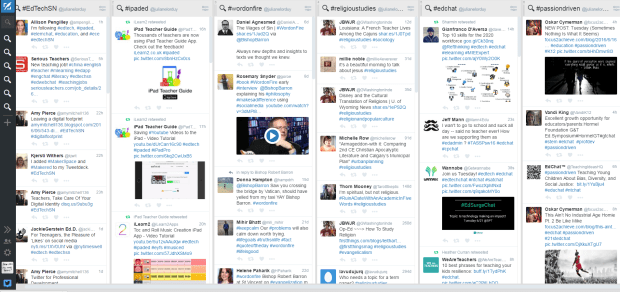
Tweetdeck

As a blog post, include a summary of (1) what hashtags you follow; (2) three new things, resources, ideas you learned by following them; and (3) your thoughts about about using Twitter as a form of just-in-time professional development. Post a link to your blog in our Facebook page and in the corresponding grading “dropbox.”

I had never heard of a Tweetdeck prior to EdTech543. I am very excited to start using this as it organize some of my favorite feeds into one place. I currently follow #EdTechSN. I found this article re-tweeted by our professor on the psychology of “Likes” in teenagers. Very interesting read with a great hook, “move over sex drugs and rock’n’roll.”  Considering that we are seeing a increase in millennials that are more concerned with staying at home, I can understand how reassurance on social media can replace or nearly replace social interaction, partying or other sorts of rewards typically sought by the teenage set. The 1950s saw a sexual-cultural revolution that continues to this day that was communicated through music. Teenage culture of old hasn’t been replaced, but is communicated and measured through social media.

I am also following #iPadEd, because our school is a 1:1 iPad byod school. To be honest, I do not see many resources here that I will use. So I may replace this hashtag with another. Perhaps I will be inspired by my cohorts’ decks. I did, however, find a link to this EdTech blog by Monica A. Burns. It has many great resources in EdTech and the quality of her blog is very inspiring. On her blog she mentions an app called, Over. It look to be a great design tool that is easy to use.

More on using twitter for personal development later!

CoPs, Connectivism and PLNs – Rain Drop Music

Communities of Practice  according Etienne Wenger have a recognizable life cycle, which passes through the stages of planning, start-up, growth, renewal and closure (Wenger, 2002.). Like this piece, there is a definite start and finish. There is also a theme that is developed throughout the piece. As the piece becomes more complicated the original theme is always present, however, the effect of arpeggiation creates degrees of separation between notes within a certain scale.

At one point the music becomes chaotic. This is purposeful and relates to the idea that connectivism draws on chaos, self-regulated learning and a “cross-polinating” learning environment (Siemens, 2004).  The music reaches a point of critcal mass at the end eventually calming down to a simpler version of its most intense self and fading out at the end.

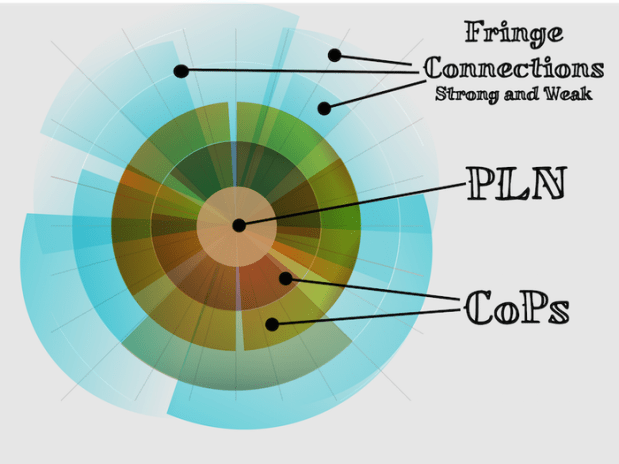
Given that these theories build upon each other, I hope that it would become clear how this piece relates to a PLN. I really like this image from a former student in EdTech 543 and I hope that it is alright that I use it to further my explanation.

connections_02.png
Photo Courtesy Renee Phoenix 2015

rain

If you were to use this image describing concentric groupings of people within a certain network and apply it to notes on a scale. The core melody or what I have been calling the theme is the PLN. As time progresses, connections between these notes and other notes, chords or rhythms become the more complex as peripheral groups form around the center, as shown in this image. Imagine raindrops on a body of water as it begins to rain. The rain starts with a couple drops here and there, which would represent PLNs. As the rain intensifies, each drop or note and its resulting ripple create many overlapping ripples spreading out forever until the intensity of the ripples dies. Eventually this rain will cease, but the water (knowledge) left behind will remain there until another effect acts on that body of water (knowledge).

Phoenix, R. (2015). Connectivism, PLNs, CoPs – in a few words. Retrieved June 12, 2016, from http://edtech.reneephoenix.com/creative_express/

Siemens, G. (2004). Connectivism: A learning theory for the digital age. Retrieved June 12, 2016 from www.elearnspace.org/Articles/connectivism.htm

Wenger, E., McDermott, R. A., & Snyder, W. (2002). Cultivating communities of practice: A guide to managing knowledge. Boston, MA: Harvard Business School Press.


EdTech 543 First Post

  • What are you initial reactions about joining these social networks for use in this course?

I look forward to seeing how this class can enhance my use of social networking in education. I have been using social networks for sometime, but I know that there is a great deal of potential for this platform that I have not explored.

  • What is your experience in using social media for your own professional development?

At school we use Schoology, a facebook-like platform for interacting with students and posting assignments. I have offered students the opportunity to create a twitter account, blog post or tumblr site based on a specific assignment.

  • What is your experience in using social media as an instructional strategy in your learning environment?

I think that is it provides students with an engaging platform of expression. Students just like the rest of the world is intrigued by social media, so being able to use it in the classroom is a huge boon.

  • What are your expectations for this course?

I really do not have any expectations. I like the writings and digital imprint of the Professor and I look forward to seeing how technology can be used to increase students’ access to material across social and economic divides.

Course Reflection

IMG_2666
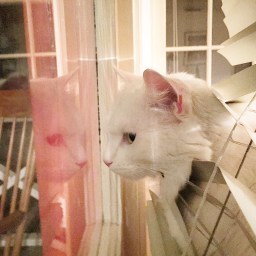
Bird the Cat, Photo by the Author.


This term of course has been a wonderful experience. While, I currently do not specialize in Education Technology, I have been working in schools for the past 8 years that have placed technology as a focus of their curriculum. Therefore, I find that the coursework has been greatly helpful in advancing my learning experiences to further address the needs of my students’ education. I look forward to continuing the journey and I hope to have Instructor Saba again in the future.

What challenges did you face in this course? 


This year presented many changes. My biggest priority was developing a challenging curriculum that suits the characteristics and academic needs of my students. This being my first year at a new school teaching a new subject matter, I had to do a lot of work to prepare myself for class each week as well as keep on top of my assignments for the EdTech program. I did not find the assignments excessively challenging and I know if I had had the luxury on only focusing on these projects, I could have done better. However, we take on as much or more than we can handle as a part of our adult life and I still found time to pick up the guitar and spend time with my new wife whom I love very much.

What strategies or other creative resources did you use to address these challenges?


I, thankfully, have Tuesday afternoons to spend in what is called the Learning Commons at my school. It is a place for students to spend their time quietly studying after school. It also gave me a quiet place to study as well. This was a special time for me to get to know some other students after school and to dedicate myself to my Boise State assignments each week. The MyMoodle portal was a great resource for getting me organized and helping me see due dates as they approached.
Which artifact do you feel was your best and why?

My best artifact for this course is Tech Trends: Musical Composition . This was also the first time in my entire life as a student that I sent my work to my professor to get feedback prior to turning it in. I feel like this was a huge boon to be as a study skill and I wish I would have picked it up a long time ago. As for the artifact, I very much enjoy music. It is one of my passions and I love finding opportunities to incorporate it into my curriculum. Professor Saba was very helpful in finding creative ways to bolster my lesson plan and I look forward to using that kind of creativity again in the future. 

What is one thing you plan to do in your school or business as a result of this course?

I plan to incorporate Learning Logs into my class curriculum for my Sophomore Theology class. I have already started using them with my students and they are an excellent way for students to see what they have been working on throughout the school year. And, it is also a wonderful way to show my administrators and department chairs what I have been doing in class students with my all year.

EdTech Graphic

edtech graphic

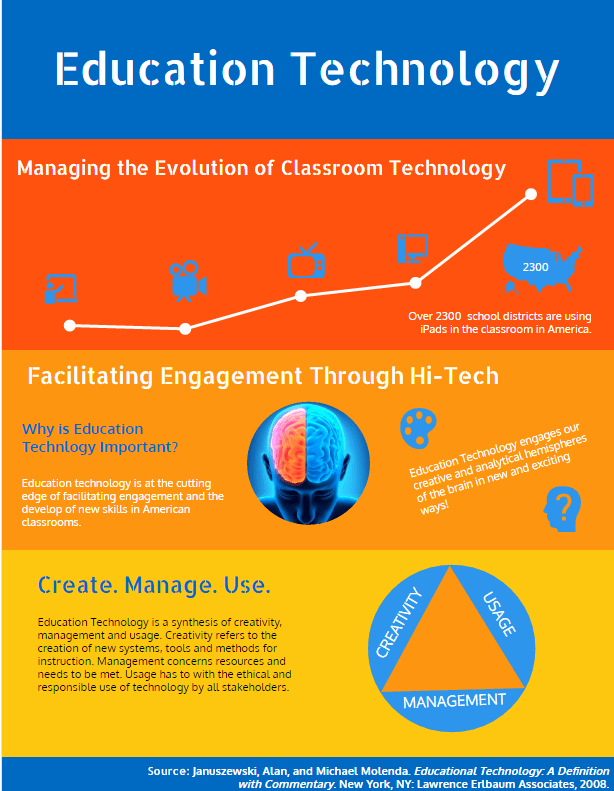
Education Technology is one of the most amazing aspects of the teaching field. It is constantly changing and it is driving the development of the classroom practices around the modern world. I look forward to discovering new opportunities to use technology in my own classroom, but ultimately I would like to pursue designing policy for technology administration at a school-wide or district level.

The graphic above, expresses the definition of Education Technology described in the text, but also incorporates on several visuals that I think are appropriate. The first is a linear graph showing the progress of classroom related technology over the last 60 years. Including the statistic, which may be dated now, that over 2300 school districts are using iPads in the classroom. The adoption of education related technology in schools is creating a demand for Education Technology specialization, which is why we are here studying this topic. The next graphic shows two hemispheres of the brain  indicating the potential for technology to integrate engagement with artistic creativity and quantitative analysis. Lastly, the triangle and circle image indicate the level of interaction between three key components on Education and Technology indicated by the text, management, usage and creation. These three elements work together to form the primary functions and aspects of Education Technology in the classroom and in school districts today.

I created his graphic using Venngage. This tool was very helpful, though I had never used it before.

School Evaluation

School Evaluation Survey

School Evaluation Report

Sacramento Valley Technology High School is an advanced school with widespread technology integration. I look forward to seeing how the school can develop in the future as a high tech environment. Students use iPad extensively throughout the school day and teacher use devices to deliver content. Each year the school revises its technology plan and incoming freshmen receive training on how to properly use their devices.

This assignment encouraged me to do some research on the background and history of my school. I have no idea that the school was founded well over a hundred years ago. The current campus has existed since 1956, however, it has received many updates and great many of them have had to do with technology. The technology lab, projection screens in ever classroom, the technology lab and iPad help desk has all encourage students and teacher to be tech savvy and take advantage of the wealth of technology resources at the school.

Tech Trends

Resources and Artifacts:

Tech Trends Lesson Plan 

Student Start Page

Personal Analysis/Experience:

 For this assignment I chose to focus on the Horizon Report concerning creativity in the classroom. Consumption in the classroom and society is ubiquitous. Certain adults grow into lives of unhappiness and dissatisfaction because too few of us have a meaningful creative outlet. There is documentation of a rise in depression in America and an increase in abuse of medication.  I believe that the arts contribute to a happier, more well rounded individual and society and science backs this up. Throughout the Horizon Report, there are references to project-based, creative learning reinventing education experiences into organic, multidisciplinary learning environments, (See, “Rethinking How Schools Work”). In my experience, it is often found that primary school education is very passive. I was happy to find in the Horizon Report this title, “Shift From Consumers to Creators,” (Johnson, 2009). This has been a goal of mine for some time in the past few years. Strangely, it is met with mixed results and reactions from parents and students. Some students are on board and relish the opportunity to work hands-on with a subject-matter in a new and interesting way. Other students are not so creative with their own creative potential and see arts integration as anti-academic. I strongly oppose this view and see art as a cathartic and meaning way to express one’s ideas, especially on a topic that is challenging to grasp. 

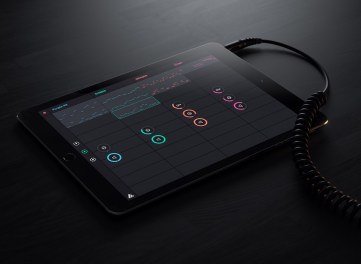
“We want to get more people making music and push music forward as an artform.” (auxy.co)

I chose to create a lesson plan that integrates technology, theology, musical arts and written analysis. The project was quite simple and produced some great results.  As a 1:1 iPad school where all students are required to bring a device by the first day of instruction, there are many possibilities available to me as an educator. Being also a hobbyist musician, I like to explore different apps that tailored to my musical curiosities. I found a very user friendly step sequencer with a geometric interface that students could learn to use in a matter minutes called, Auxy. Thanks to the Auxy app, students were able to dive into music composition and recording in a very short period of time. Then, I began thinking of ways that students can explore different subject matter from an arts integration mindset.

While creating this activity, I understood that many students are not comfortable expressing  themselves in a purely musical way. The app, Auxy, removes barriers. Once I had figured out a foolproof way for music creation, I had to backup the work that students would be doing with some skills that they are already practicing in other classes. So I decided that they should have a writing component where they should describe why the sounds, tempos and feelings associated with their music connects to the Paschal Mystery.

The final component of this lesson is to have students play their recorded piece of work for the class and read their written component aloud to the class. Students were nervous about showcasing their work, but after everyone had made their presentations, I felt that students enjoy hearing each other compositions. Once everyone had submitted and presented their works, I compiled the musical pieces into a file that could be shared with the students and burned the tracks onto a CD.  
Conclusion:

I think that this lesson was a fun and engaging way to interact with a subject that can be very difficult to discuss, express and intellectualize. The Paschal Mystery is the central theological mystery of the church surrounding Christ’s sacrifice, death and resurrection. It really can only be expressed through metaphors and symbols. I feel that music has been a powerful way over the centuries for people to express the wide variety of emotions associated with the Passion. Now students can engage with this subject through music using technology in a way that is very accessible.  Creativity in any form is the new currency of the marketplace, value by CEOs above integrity and global thinking (Briggs, 2014). The challenge with successful arts integration is implementing it in a meaningful way for students. Scholars have identified these criteria for successful implementation:

“1. Students should see connections and walk away with bigger ideas.

  1. Students should take their work seriously.
  2. The expressions and activities in the arts should genuinely speak to important areas of the academic curriculum. This also means that the content is seen through more than one form, for example, beyond the traditional written and spoken word.
  3. The content lesson and the artistic lesson should be of equal importance.
  4. The experience should have a planned assessment with rubrics and scoring guides.
  5. The lesson plan should grow from state curriculum standards in both content areas and the arts.” (Catterall and Waldorf 1999, 58)

In my lesson, I believe that I prepared students in a way that made the lesson authentically meaningful. There may be room for improvement on connecting larger ideas to this subject matter. In the start page for the lesson, I included several references to music that was inspired by the Paschal Mystery, which I hope helped student to connect what they were doing to the larger world and the legacy of inspired works of art associated with the subject matter.

iPADIt was very important to me that my students leave my classroom realizing that they can be creative even if they have been told (tell themselves that they are not skilled at art). I also appreciate the ability to have students explore difficult concepts through art, I think that it helps students exercise parts of the brain that we do not often have the opportunity to use.
 

Resources:

Briggs, S. (2014, September 20). Students as creators: How to drive your students to be   more than just consumers – InformED. Retrieved April 08, 2016, from http://www.opencolleges.edu.au/informed/features/students-as-creators/

Catterall, James S., and Lynn Waldorf. (1999). The Chicago Arts Partnerships in Education: Summary evaluation. In Champions of change: The impact of arts on learning, ed. Edward B. Fiske, 47–62. Washington, DC: Council of Chief State School Officers.

Johnson, L., Levine, A., & Smith, R. (2009).  The 2009 Horizon Report.  Austin, Texas: The New Media Consortium.


The Digital Divide

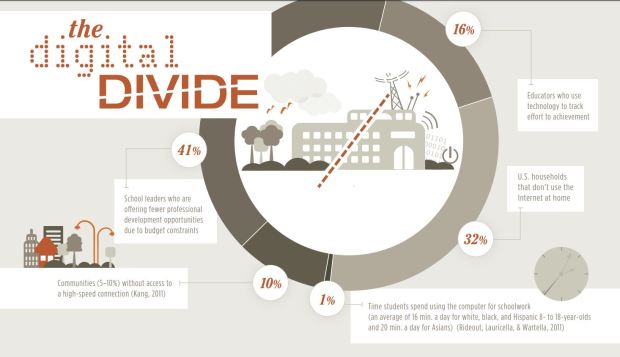
The following Voice Thread presentation concerns the digital divide and how it affects students in our modern society. In a previous assignments I discussed the demographic and unique situation that exists at my school. I chose to expand my focus to address issues affecting larger communities and the nation as a whole. My school does a great deal to accommodate students with financial hardships. But that is a sliver of the local population. I would like to see a practical campaign sponsored by local governments and school districts. Here you will find my Google slide show.

Every major city in California has been affected by the tech boom in the San Francisco Bay Area. Housing prices have shot upwards even in Sacramento (75 miles away from the bay area). Yet, wages and salaries for the majority of the state’s citizens have not increased equally. And given record profits for companies effecting this trend and the insistence that technology is the way of the future, I believe companies should be partnering with school districts and governments to create an availability of devices to especially young people and their families. The innovative and tech savvy communities can become the more successful they will be. The computer can be young people’s portal outside a world of poverty, crime or despair. As fellow EdTech student, Art Schultz, mentioned in his Research Assignment, devices can be used to treat feelings of alienation. Why can’t they also give students homework, information and self-help resources in areas that need it the most?

Michio Kaku keeps celebrating that fact that soon enough it will cheap enough to paint entire walls with lcd computer screens (Physics of the Future). Why can’t we provide internet, devices and tech education to communities that use it most? I would like to see more people address this issue in the coming years as technology become more and more an essential aspects of our changing world. ddivide.JPG