Social Media in High School Education

This week I went through Pinterest and Google looking for examples of successful uses of social media in classroom assignments. There is a great deal of content available, however, I can see how there is a lot room to explore new and different ideas for using Social Media in the classroom. Please visit the link to my Pinterest board where I mentioned all the different classroom learning ideas that I discovered while doing my search. In the comments, I also described some simple and straight forward ideas for applying these techniques in the high school classroom setting.

The examples listed in the board show how students can use social media for assessment, research, and communication. I appreciate that there are several example from high ed for using social media, because sometime I feel that the elementary and secondary school levels are unique in using education technology so extensively. However, students are on social media. In many ways their personal relationships and online relationships are deeply inter-connected; you cannot have one without the other. Therefore it will be very useful for teacher to tap into this world. I want students to see that they content teaching it relevant to their world. If we use social media we can have students personal lives interconnect with their learning.

I think that the most inspiring use for social media in the classroom is for re-creating the PLE and PLNs for students to use. I want to use Twitter in a safe way to allow students to communicate with each other and outside world on issues that are relevant to the class.

Webinar on Education Technology

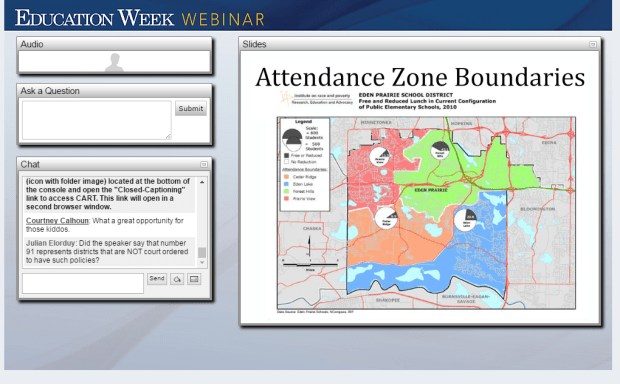
edtech webinar.PNGEducation Week – Teachers Perspectives on Education Technology

This webinar discussed the results of a survey on EdTech conducted on the Education Week website. According the presenter, it represented diverse community of teachers, but does not statistically reflect the teachers across the United States. The data states that many teachers do not have a positive outlook on the current state of Education Technology, however, the outlook on the future looks slightly better for teachers.

It seems that these issues have to do mainly with the fact that, even though every single stakeholder in education understands that Education Technology must play a part in student education, not everyone understand how it should play out and where resources should be spent when technology changes so quickly. I seems that companies of hardware and software are in a winning position financially, while schools are in a losing position. If the next phase of our existence contains an augmented reality.

I am deeply concerned that a large majority of children and their parent may be left out when access to the technology necessary to participate in the augmented, asynchronous reality is not available. I look forward to governments and companies find ways to solve this issue and increase funding and professional development for teachers everywhere who might be intimidated by education technology.

My PLE Diagram and Reflection

PLE Diagram (1).png

This week for Module 5 we were asked to create a Personal Learning Network (PLE) diagram to show our connections to various online communities and resources that we frequent. I used a new platform for me called, Draw.io. However, it works almost identically to Gliffy. I will say that I used the benefit of other students’ diagrams to help craft my own. I certainly made it easy not to be the very first one to submit.

I think that in this world we are sometimes overly connected. However, I have come to revise my thinking on this subject. According to Clay Shirkey, we are not suffering ever from a information overload, rather a failure to filter. In a similar way, I do not think we are ever overly connected, but we do not make the best use of our connections. I often find myself lurking in the shadows and not making an contributions to online communities. This week has been a wonderful lesson in becoming  a participant. I look forward to using this skill more in the future.

I reviewed the diagrams of Allison Pengilley, Amanda Hensley, Kimmy Davis and Megan Apgar. I noticed a lot of continuity between the content of each diagram. I also noticed a lot of variety and creativity in the my fellow students’ means for capturing their PLE diagram. I especially liked Amanda Hensley’s connectivity plate. By showing each connection as a serving on a plate, she creatively indicated which network is most important to her and, on which, she spends to the most time developing connections. Allison Pengilley’s was the most inspiring to me because it was the cleanest and one of the most visually attractive. I tried to emulate that level of cleanliness and took advantage of the tools available in the Draw.io software. I, also, noticed that Allison’s diagram included a couple resources that I use, but would have neglected to include, such as, Pinterest and Google Drive. So, I made sure to include them in my diagram. Thank you all for your great efforts and being an inspiration to me in my EdTech networking journey!

Twitter Chats for EdTech 543

Below are my reflections on my discussions in these Twitter chats. It was a very inspirational journey. There are many people working hard to brand themselves and produce and curate great content for the Twitter world. I look forward to using some of their ideas and tools to help myself in my career in education. twitter chat - best classroom

#sunchat (7/3/2016)

A collection of inspirational resources regarding education. I am very fascinated with this approach to personal development. It makes the process, so incredibly fluid and increases the amount of exposure to content from educators. In one post, I replied to Dr. Randall Sampson’s message, “Innovative schools have a clear focus on the continuous development of their teachers.” I have found this to be so true. In my last school there was not vision for development and it has a strongly negative effect on enrollment and morale. I also discovered a useful diagram showing the importance of peer evaluation in education. I replied, reposted and liked posts that struck a chord with me.

#edslowchat (7/3/2016)

Today a question was posed asking teachers what they are reading. It was very interesting to discovered that there weren’t just a random collection of various education related texts being reposted, but that there are a number of buzz titles that were listed several times. Those included, Hacking Leadership by Joe Sanfelippo, Kids Deserve It by Todd Nesloney, and Launch by John Spencer. I was able to like posts feature texts that I would like to read and I shared some of the texts were are reading this summer for the EdTech program.

#sunchat (7/10/2016)                                 

Today several interesting subjects came up in our chat. One of the most important came from Rita Wirtz (@ritawirtz). She linked to an article she has written having to do with the instance of problem children finding their way into the penal system, because the school system could not save them. I replied at having been inspired by her writing, but I was a little disappointed she didn’t point the readers to any solutions or any resources of groups that are working to address the issues she brings up. I also came across a link to an article on Elie Wiesel. It was a beautiful article. I teach about the history of persecution against the Jews in my comparative religion classes. It is always necessary to revisit Elie Wiesel writings. I appreciated being reminded of his words today on the chat.

#edchat 7/11/2016

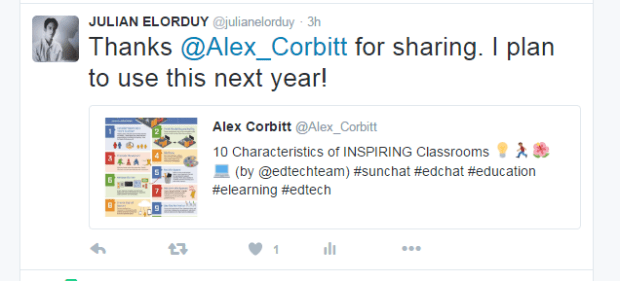
During todays on-going chat on education, I found some great content and some inspiring content curators. Alex Corbitt is a teacher in Bronx, NY. Today, he posted an infographic describing 10 characteristics of inspiration creating classrooms. He has a focus on socio-emotional learning and gamification in the classroom. I reposted and commented on the infographic that he posted. Aside from Mr. Corbitt, there is a wealth of resources following this hashtag and a majority of the content to applicable and focused. Twitter does a great job of filtering content that is not suitable for the discussion. The Google Plus communities do not have this benefit.

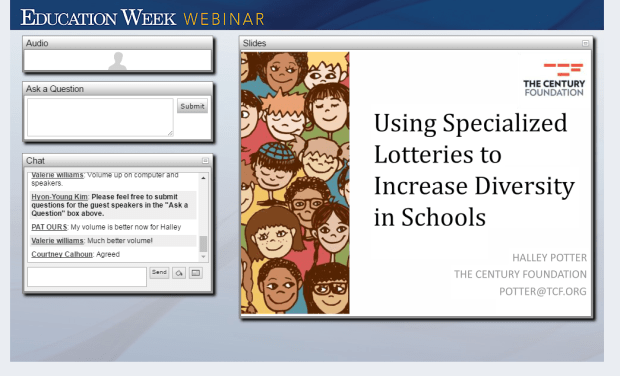
Education Week Webinar – Using Lotteries to Increase Diversity in School Districts

This webinar is a discussion of strategies for integration in school districts, specifically using lotteries in increase diversity. The key presenter shows that since 1996 to the present day the number of districts with integration policies have increase dramatically. However, there is still a long way to go. Strategies include redrawing district boundaries and choice-based integration. Choice based integration strategies include magnet schools, charter schools, transfer policies, and district-wide equitable choice strategies.

To create effective weighted lotteries the speakers states that districts should consider the landscapes (relationships between schools, enrollment numbers, etc.). And she also believes that diversity goals need to come before choosing a mechanism.  Mechanisms to increase integration and diversity need to be flexible and adaptable so that communities can draw on their strengths and achieve goals more rapidly. Weighted lotteries should come with recruitment by combining attractive schools to draw families into these schools.

The webinar included a presentation from Brooklyn Prospect Charter School. There are a variety of state and federal laws that must be taken into consideration. Charter schools face limitations based on these laws. A voice for Charter schools is the National Alliance for Public Charter Schools informs us that some states are silent on admissions preferences, some expressly permits weighted lotteries, interpreted to permit weighted lotteries for the disadvantaged, some limited the lotteries.Brooklyn Prospect Charter School  is a K-12 College Preparatory. It’s are finding excellent teachers and creating a diverse student body. At the school currently, there is no racial majority, and an even economic split. The schools aims to focus on these goals: (1) A strong academic program (2) strategic facility placement and (3) agile admissions strategies.

The webinar tool is a great resource. I personally prefer asynchronous content, because scheduling time to engage in one of these webinars can be a challenge. However, I liked the immediate feedback and the ability to ask questions in real-time. Webinar - Lotteries for Diversity 2Webinar - Lotteries for Diversity.PNG


Curation Complete: Scoop.it and EdTech’s Effetiveness

Curation for EdTech 543 on Scoopt.it

It took quite a while to narrow in on a topic in Scoop.it. The platform is very attractive and works very well. But it was difficult to find content in specific areas within the Scoop.it search tools. However, I was able to focus on how 1:1, BYOD and education technology are working together in research and studies, either official studies or anecdotal evidence from teachers around the country. In the body of evidence collected in this curation overwhelmingly it appears that schools need to focus on PD and innovation. And teachers need to organize their tech integration for fluidity. Regardless, this subject opened up a lot of content published to online education journals and personal blogs.

See our PLN’s criteria below.

Criteria for Curation

Assessment:

Relevance: When considering the relevance of content in curation:

  1. Has a niche/theme been identified and does the curated piece fit that niche/theme?
    • Each resource fits within the identified niche. 
  2. What is the value of the curated piece in relation to the theme?
    • Each piece of content fits into the theme of trying to assess the effectiveness of Education Technology as it is implemented today. My insights point to directions for further success in addressing challenges in the future. 
  3. Has the piece been filtered for originality and quality?
    • Some resources have been re-Scooped from other Scoop.it users, but otherwise each piece is relevant and unique to the topic and drawn from reputable resources. 
  4. Is there evidence of inquiry in the piece? Going beyond the surface of the theme?
    • I’d like the reader to be presented with a variety of opinions on the subject-matter. So that they can make their own determination on how effective education technology can be in the classroom. 

Authority: When considering authority:

  1. Is there proper attribution in the piece itself?
    • When necessary, each resource is properly attributed. Some pieces are original and do not require attribution.
  2. Does the curated list reference both the presenter and the original creator of the content to the best of the curator’s ability?
    • All resources show proper attribution and are taken from public websites. 
  3. Does the list contain pieces from recognized authorities or creators with credentials or experience?
    • The pieces come from notable authors in the field of education, teachers, bloggers and researchers. 

Purpose: When considering if curated content has a specific and useful purpose, consider the following thoughts:

  1. Is there evidence of editorializing to provide context for the curated content?
    • The selection of each resource adds dynamics to the theme by creating substance and outlining alternative perspectives. 
  2. Is there a summary that provides rationalization for a resource’s inclusion in a curated list?
    • My insight added to each article provides a brief summary and commentary, which highlight the reasons for inclusion. 
  3. If the curator uses a social media site like Twitter to share resources, have they included their own perspective?
    • This post and posts on the Scoop.it sites are posted using #edtech and #edtech543 hashtags. 
  4. Does the information fit into a clearly identifiable theme?
    • All content in the curation fits to the theme of how education technology is working or not working within a school setting.

Presentation: Strong content curation tools must be easy to use, simple, and straightforward. In order to assure that your curated content is presented and shared effectively, think about the following questions:

  1. Has the curator chosen an appropriate presentation tool for its intended audience?
    • Scoop.it is an attractive and focused website used for content curation. 
  2. Does the curated list address the needs of the intended audience?
    • Each piece is intended for educators or administrators who are trying to understand how education technology can be most effective. 
  3. Has the curated listed been organized in a clear, concise, and easy to understand manner?
    • The resources are labeled with accurate titles that point to the meaning of the article. If a title was misleading, I provided insight to clearly identify summary the true content of the article. 
  4. Is the list easily sharable by its users?
    • Scoop.it allows all users to share and re-“scoop” content. 
  5. Is the chosen format updated regularly with new information?
    • Scoop.it allows you to find new resources every time that you login in to the site. 

Criteria for Curation and a Reflection on the Process

Criteria for Curation and a Reflection on the Process – Google Document

This assignment required us to create 15-20 different criteria to use measure our future effectiveness at being quality web curators, who according this article are the “Web’s New Superheroes.” With the deluge of content filling the web, it is increasingly essential for the content to be filtered, analyzed and qualified by talented web curators. I am still learning how this can be applied to education. I would like to study the work of expert education curators on the web and understand how they decide their niche, where they pool for resources and how they manage their workflow, assuming web curation is not their primary job. I look forward to being able to flex these powers in the next weeks.

This assignment required a flexing of our collaborative skills. Our PLN got the ball rolling by creating a Google Document for the list of criteria and frame our discussion. A member of the PLN introduced us to the idea of the CRAAP model by the CSU system. It was a challenge to completely allow the CRAAP test to conform to the guidelines of the assignment. But it did give us a convenient framework, around which, we could organize our criteria.

We ended up using some elements of the CRAAP test and ultimately made it our own. Based on test, added 16 criteria, which, were gleaned from the readings and resources that we gleaned from the web. Ultimately, this was a group effort. But I feel indebted to the hard work of the group in finishing the assignment so early. I would definitely still be working on this if weren’t for the diligence and skill of PLN.


Reflections on the Nature of Digital Footprints…

I find it oddly comforting that if I want to discover information about a person, I can find a lot of it online. As a more introverted person with an innate curiosity of other people, the web provides as a wonderful means of attaining information and doing some people watching via the comfort of my own home. And I do not think I am alone. In many levels of interaction within society, we are compelled to google those people, with whom, we are fascinated. Whether it be a love interest, a colleague or a new friend, we tend to want to know all that we can know about that person. I am not sure this is fair, but it is the nature of our world. Fortunately or unfortunately, a great deal of information can be found in the world about virtually anyone. It is at once comforting and disturbing. But how comfortable should we be with the knowledge that anything that is written about us or content that is created by us can be found online? The internet is not a playground where we are immune from impunity, especially for those of us whose professional lives dwell online and in person.

As for my own digital footprint, there is a legacy of photos, videos and music that I have created since I was 19 or 20. I have been a part of indie, lo-fi music making for over a decade now. It has been a passion that I have carefully balanced with work and school. I believe that it adds a layer to my personality and life-experience and I do not regret it one bit. I only perhaps wish that I had had more time to devote to it more fully. Regardless, when you search for my name the first 4 or 5 results are related to my music. And that is ok! I love making music and I am not ashamed or embarrassed. It is a historical record of my time as a young person and I still continue to make music to this day. I look forward to, however, advancing my professional online presence and developing a digital footprint that will help me succeed in the future as a Religious Studies instructor and an Education Technologist.

10 Tips for Developing and Keeping a Positive Online Reputation

IMG_2666

1. Google Your Name Regularly (Kujawski, 2012)

Google is a top resource for all people on the internet. It is common knowledge that any potential employer, student or colleague may Google your name and find out anything they can about you. At my new school last year, I was embarrassed by students walking past me giggling and not understanding the nature of their extra attention towards me. It turns out they had found a couple of music videos that I had made for a band I was in several years ago. Luckily, there wasn’t anything inappropriate in the video and it was made in good fun. You might even call it art! However, it is a jarring wake-up call to realize that everything that I have ever left on the internet can be found by my students. Even the office staff confessed to having watched the videos I made. While this is was a relatively innocuous event, it made me very cautious of everything I put on the internet.

2. If Your Cant’t Find It on Google, It Might As Well Not Exist. (Lowenthal, 2012)

Again, Google is a top resources, so if you have some evidence of a professional or personal accomplishment that cannot be found on Google it might as well not exist. Strange that you can be sure of your accomplishments, however, to the digital world “pics or it didn’t happen” is a real force behind the court of public opinion. Be sure that your past employment, blog posts and any special awards or moments of recognition are documented and available online. I am seeing now how it would also be important to document your slideshows by posting them to SlideShare with relevant tags and posting your most accomplished projects and written works to a blog or personal website.

3. Create and Control Your Online “Unique Value Position”  (Kujawski, 2012)

I especially like this tip, because it relates deeply to what we have already learned in this class and to later tips in this list. Your “Unique Value Position” relates the Neo-Liberal or Branded Self (discussed below). It is that position which can be monetized. Who am I? What professional skills do I offer? In this class, we have discussed the importance of social networking in professional develop in CoPs and PLNs. Your UVP is your ability to produce content or teach skills that can be of value to others. This is especially important for the 21st century and professionals of all over the world. We have to be our own advocate and occasionally toot our own horn, so to speak.

4. Don’t Share What Do You Don’t Want Your Grandmother to See (Koekemoer, 2012)

This is a golden rule for sure. At this point in our professional careers we are most likely mature enough to realize that our private lives and professional lives too often overlap. And our pictures from our early twenties can haunt us for a long time. Take control of what you post and who can see it. Old albums of photos on Facebook need to be hidden or deleted. Keep yourself safe and protected. Not everything that we do needs to be known by our employers or prospective employers.

5. Be Consistent (Koekemoer, 2012)

Creating an online brand is difficult and challenging. What is more frustrating about the deluge of content on the internet is that if you are inconsistent about your digital presence, your audience will turned off your feed and eventually your content will fall to the bottom of their feeds. One must not become obsolete or irrelevant by  failing to keep up with their digital presence. This is a challenge for me as I tend to be a dreamer and planner, and start many things without following them through to fruition. I look forward to challenging myself to post at least 1-2 blog posts outside of what is required for this class per week.

6. Create and Keep Current Your LinkedIn Account (Hacker, 2011)

If you have been paying attention to the purchase of LinkedIn by Microsoft, you may have read the lofty goals the company has set for itself in terms of professional networking. If you wish to establish a UVP, LinkedIn may be on of the best places to reach an audience of colleagues and potential employers. It has also been a great place to link creative content from your professional career. It is important to keep this information fresh and up to date even if you are employed and comfortable in your current position.  Be sure to think about the potential benefits to having a competitive LinkedIn account in your field. It also makes your employer proud to call you a member of their team and reassures them of your value within their company. I would imagine that it could also constitute bargaining potential salary negotiations.

7. Blog Before Publishing (Lowenthal, 2012)

At this point in our career (speaking to students in the Masters program at Boise State), we may not be concerned with publishing. So I believe the advice set forth in the article by Professor Lowenthal is important. We should be our own advocate, publishing our own work on our blogs and keeping ourselves relevant. It is possible that one day our blog could be supported by larger sites that could connect you with a larger audience. This would be a great boon to your career and not inconceivable.

8. The Divide Between Online and Off-line is Hazy and Possibly Irrelevant (Levine, 2012) (Jurgenson, 2011)

Digital dualism is not a thing anymore. What we say and do online can have effects on our day-to-day lives and certainly our livelihood. This is true for students and for educators. Our digital presence is an extension of our organic reality. As Jurgenson states, “We are not crossing in and out of separate digital and physical realities, ala The Matrix, but instead live in one reality, one that is augmented by atoms and bits.” This is a powerful concept. While I think that The Matrix has more to do with denial inducing power structures within our organic and digital realities, the idea that our lives are organic and digital all at once requires a lot of pondering. If this is true, then there is an issue of equality that deserves attention as a large number of people either have limited network access and many people are limited in their understand of the language of networking and computing. This must all be address in the coming years along with other issues affecting society.

9. Be Aware of the 6 Key Public Selves (Stewart, 2012)

Is anyone feeling like they have a split personality disorder after reading this? Well listen to this. According Bonnie Stewart, she has identified 6 Key Public Selves: the performative, quantified, participatory, polysocial or augmented reality self and the neo-liberal branded self. I am not certain that these need to be separated into so many different categories. But I do recognize that they exist within the phenomenon of the networked self. Certain aspects of this “augmented reality” are down right narcissistic. For example, the quantified self refers to one’s capacity to maximize likes or social media “klout.” And I agree that the performative, public nature of the networked self does create a competitiveness that is interesting to analyze. In trying to gain a following, I am curious how often the filter of self-consciousness diminishes the authenticity of one’s digital persona. Not to mention how the quest for likes may create an appeal to popularity sort of mania.

As with all change, development or revolution there are cost and benefits. Let’s look at the asynchronous self.  I truly appreciate this quality of the social network. Direct messages from my mother when she knows I am on FB because of the green circle that appears by my name creates an anxiety that is very distracting from my workflow. I know this is selfish, but wouldn’t it be nice if she just collected all of her little anecdotes about her dogs and my dad and gave me a weekly update via email? If only! Such communication along with telephone calls are frustrating because they can disrupt your work patterns. I am sure that generations before us would read such things with baffled amusement. How can we neglect our loved ones in real-time to meet or deadlines  or correspond with colleague via the online network asynchronously?  Well, when my mother sees that I am online on FaceBook, she assumes I must  be free to chat, because, for her, Facebook is a source entertainment during her leisure time. To us, it is a tool for our professional development.  The asynchronous self assumes that I do not have to be ‘live’ on the network to still participate or be active. Finally, the branded self is the aspect of our online identity that seeks to monetize ourselves. It requires us to find our niche. I am planning to make a goal in the next year to create a consistent web presence focused on the skills that I am developing in the classroom and the qualities of my networked self that I am developing in the EdTech program.

10. Proactively Protect Your Social Map (Clark, 2014)

Our social map can be very useful. It can be empowering and it can damning. I have lost friends based on social-political discussions. I have alienated friends because of my profession (teaching at a Catholic School). My social map is a valuable learning conduit from which I can gain a unique perspective about the world through my connections. However, I can also make public aspects of my identity which may not be relevant or necessary for the world to see. Accordingly, if I am careless with my social map and the connection I make, it can have dire consequences for my future and the legacy I leave behind in the digital world which will most likely outlive me.


References:

Clark, M. (2014, July 24). Digital footprints | Michelle Clark | TEDxHollywood. Retrieved June 19, 2016, from https://www.youtube.com/watch?v=NlGyTp4Nd4M

Hacker, P. (2011, February 14). Creating your web presence. Retrieved June 18, 2016, from http://chronicle.com/blogs/profhacker/creating-your-web-presence-a-primer-for-academics/30458

Juregneson, N. (2011, February 24). Digital dualism versus augmented reality. Retrieved June 19, 2016, from https://thesocietypages.org/cyborgology/2011/02/24/digital-dualism-versus-augmented-reality/

Koekemoer, A. (2012, April 8). Your digital footprint in a social media world. Retrieved June 18, 2016, from http://www.slideshare.net/AntonRSA/your-digital-footprint-in-a-social-media-world

Kujawski, M. (2012, May 17). Managing your personal digital footprint. Retrieved June 18, 2016, from http://www.slideshare.net/mikekujawski/tools-and-tips-for-managing-your-personal-digital-footprint

Levine, A. (2012, March 21). We, our digital selves, and us. Retrieved June 19, 2016, from https://youtu.be/9ziS3mpjgvI

Lowethal, P. .. (2012, January 5). Intentional web presence: 10 seo strategies every Academic needs to know. Retrieved June 19, 2016, from http://er.educause.edu/articles/2012/6/intentional-web-presence-10-seo-strategies-every-academic-needs-to-know

Stewart, B. (2012, May 6). Digital identities: six key selves. Retrieved June 19, 2016, from http://theory.cribchronicles.com/2012/05/06/digital-identities-six-key-selves/


Twitter for Professional Development

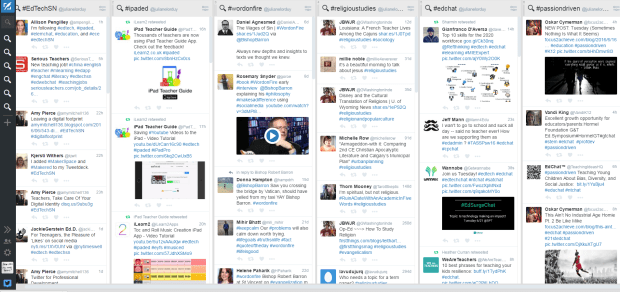
Tweetdeck

As a blog post, include a summary of (1) what hashtags you follow; (2) three new things, resources, ideas you learned by following them; and (3) your thoughts about about using Twitter as a form of just-in-time professional development. Post a link to your blog in our Facebook page and in the corresponding grading “dropbox.”

I had never heard of a Tweetdeck prior to EdTech543. I am very excited to start using this as it organize some of my favorite feeds into one place. I currently follow #EdTechSN. I found this article re-tweeted by our professor on the psychology of “Likes” in teenagers. Very interesting read with a great hook, “move over sex drugs and rock’n’roll.”  Considering that we are seeing a increase in millennials that are more concerned with staying at home, I can understand how reassurance on social media can replace or nearly replace social interaction, partying or other sorts of rewards typically sought by the teenage set. The 1950s saw a sexual-cultural revolution that continues to this day that was communicated through music. Teenage culture of old hasn’t been replaced, but is communicated and measured through social media.

I am also following #iPadEd, because our school is a 1:1 iPad byod school. To be honest, I do not see many resources here that I will use. So I may replace this hashtag with another. Perhaps I will be inspired by my cohorts’ decks. I did, however, find a link to this EdTech blog by Monica A. Burns. It has many great resources in EdTech and the quality of her blog is very inspiring. On her blog she mentions an app called, Over. It look to be a great design tool that is easy to use.

More on using twitter for personal development later!