Resources and Artifacts:
Personal Analysis/Experience:
For this assignment I chose to focus on the Horizon Report concerning creativity in the classroom. Consumption in the classroom and society is ubiquitous. Certain adults grow into lives of unhappiness and dissatisfaction because too few of us have a meaningful creative outlet. There is documentation of a rise in depression in America and an increase in abuse of medication. I believe that the arts contribute to a happier, more well rounded individual and society and science backs this up. Throughout the Horizon Report, there are references to project-based, creative learning reinventing education experiences into organic, multidisciplinary learning environments, (See, “Rethinking How Schools Work”). In my experience, it is often found that primary school education is very passive. I was happy to find in the Horizon Report this title, “Shift From Consumers to Creators,” (Johnson, 2009). This has been a goal of mine for some time in the past few years. Strangely, it is met with mixed results and reactions from parents and students. Some students are on board and relish the opportunity to work hands-on with a subject-matter in a new and interesting way. Other students are not so creative with their own creative potential and see arts integration as anti-academic. I strongly oppose this view and see art as a cathartic and meaning way to express one’s ideas, especially on a topic that is challenging to grasp.
“We want to get more people making music and push music forward as an artform.” (auxy.co)
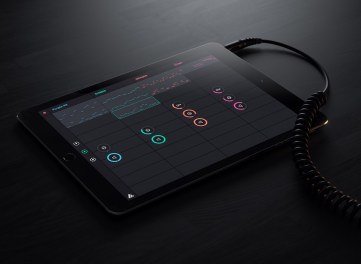
I chose to create a lesson plan that integrates technology, theology, musical arts and written analysis. The project was quite simple and produced some great results. As a 1:1 iPad school where all students are required to bring a device by the first day of instruction, there are many possibilities available to me as an educator. Being also a hobbyist musician, I like to explore different apps that tailored to my musical curiosities. I found a very user friendly step sequencer with a geometric interface that students could learn to use in a matter minutes called, Auxy. Thanks to the Auxy app, students were able to dive into music composition and recording in a very short period of time. Then, I began thinking of ways that students can explore different subject matter from an arts integration mindset.
While creating this activity, I understood that many students are not comfortable expressing themselves in a purely musical way. The app, Auxy, removes barriers. Once I had figured out a foolproof way for music creation, I had to backup the work that students would be doing with some skills that they are already practicing in other classes. So I decided that they should have a writing component where they should describe why the sounds, tempos and feelings associated with their music connects to the Paschal Mystery.
The final component of this lesson is to have students play their recorded piece of work for the class and read their written component aloud to the class. Students were nervous about showcasing their work, but after everyone had made their presentations, I felt that students enjoy hearing each other compositions. Once everyone had submitted and presented their works, I compiled the musical pieces into a file that could be shared with the students and burned the tracks onto a CD.
Conclusion:
I think that this lesson was a fun and engaging way to interact with a subject that can be very difficult to discuss, express and intellectualize. The Paschal Mystery is the central theological mystery of the church surrounding Christ’s sacrifice, death and resurrection. It really can only be expressed through metaphors and symbols. I feel that music has been a powerful way over the centuries for people to express the wide variety of emotions associated with the Passion. Now students can engage with this subject through music using technology in a way that is very accessible. Creativity in any form is the new currency of the marketplace, value by CEOs above integrity and global thinking (Briggs, 2014). The challenge with successful arts integration is implementing it in a meaningful way for students. Scholars have identified these criteria for successful implementation:
“1. Students should see connections and walk away with bigger ideas.
- Students should take their work seriously.
- The expressions and activities in the arts should genuinely speak to important areas of the academic curriculum. This also means that the content is seen through more than one form, for example, beyond the traditional written and spoken word.
- The content lesson and the artistic lesson should be of equal importance.
- The experience should have a planned assessment with rubrics and scoring guides.
- The lesson plan should grow from state curriculum standards in both content areas and the arts.” (Catterall and Waldorf 1999, 58)
In my lesson, I believe that I prepared students in a way that made the lesson authentically meaningful. There may be room for improvement on connecting larger ideas to this subject matter. In the start page for the lesson, I included several references to music that was inspired by the Paschal Mystery, which I hope helped student to connect what they were doing to the larger world and the legacy of inspired works of art associated with the subject matter.
It was very important to me that my students leave my classroom realizing that they can be creative even if they have been told (tell themselves that they are not skilled at art). I also appreciate the ability to have students explore difficult concepts through art, I think that it helps students exercise parts of the brain that we do not often have the opportunity to use.
Resources:
Briggs, S. (2014, September 20). Students as creators: How to drive your students to be more than just consumers – InformED. Retrieved April 08, 2016, from http://www.opencolleges.edu.au/informed/features/students-as-creators/
Catterall, James S., and Lynn Waldorf. (1999). The Chicago Arts Partnerships in Education: Summary evaluation. In Champions of change: The impact of arts on learning, ed. Edward B. Fiske, 47–62. Washington, DC: Council of Chief State School Officers.
Johnson, L., Levine, A., & Smith, R. (2009). The 2009 Horizon Report. Austin, Texas: The New Media Consortium.
 Julian A. Elorduy, MET, MA