Communities of Practice according Etienne Wenger have a recognizable life cycle, which passes through the stages of planning, start-up, growth, renewal and closure (Wenger, 2002.). Like this piece, there is a definite start and finish. There is also a theme that is developed throughout the piece. As the piece becomes more complicated the original theme is always present, however, the effect of arpeggiation creates degrees of separation between notes within a certain scale.
At one point the music becomes chaotic. This is purposeful and relates to the idea that connectivism draws on chaos, self-regulated learning and a “cross-polinating” learning environment (Siemens, 2004). The music reaches a point of critcal mass at the end eventually calming down to a simpler version of its most intense self and fading out at the end.
Given that these theories build upon each other, I hope that it would become clear how this piece relates to a PLN. I really like this image from a former student in EdTech 543 and I hope that it is alright that I use it to further my explanation.
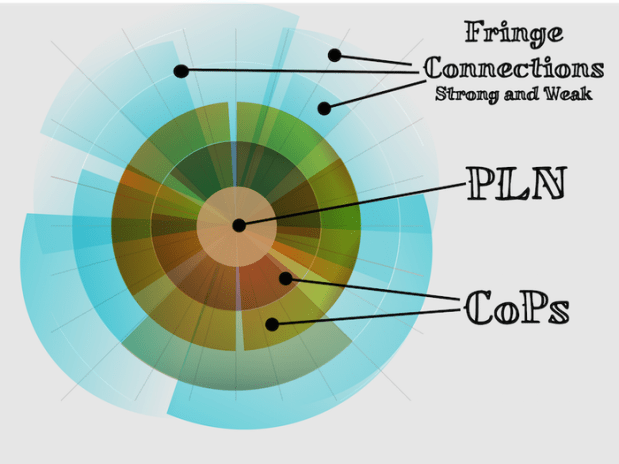

If you were to use this image describing concentric groupings of people within a certain network and apply it to notes on a scale. The core melody or what I have been calling the theme is the PLN. As time progresses, connections between these notes and other notes, chords or rhythms become the more complex as peripheral groups form around the center, as shown in this image. Imagine raindrops on a body of water as it begins to rain. The rain starts with a couple drops here and there, which would represent PLNs. As the rain intensifies, each drop or note and its resulting ripple create many overlapping ripples spreading out forever until the intensity of the ripples dies. Eventually this rain will cease, but the water (knowledge) left behind will remain there until another effect acts on that body of water (knowledge).
Phoenix, R. (2015). Connectivism, PLNs, CoPs – in a few words. Retrieved June 12, 2016, from http://edtech.reneephoenix.com/creative_express/
Siemens, G. (2004). Connectivism: A learning theory for the digital age. Retrieved June 12, 2016 from www.elearnspace.org/Articles/connectivism.htm
Wenger, E., McDermott, R. A., & Snyder, W. (2002). Cultivating communities of practice: A guide to managing knowledge. Boston, MA: Harvard Business School Press.


I like the music; you are certainly talented. Your description of what the music means is important, because without it I would have struggled to see the connection between the musical progression and the ideas. I don’t necessarily think that’s a bad thing because music is highly subjective to begin with. But once you explained it, it made sense. I also thought the rain analogy was a good one, particularly as you can imagine, or even see, the effects ripples have on one another.
LikeLike